| ||
  2026 Sistema Cheve
|
Exploration Summary of the Cheve 2026 Expedition
Between February 1 and April 27, 2026 an international team of 28 explorers from five countries sought to extend exploration of Sistema Cheve beyond the northern limits of the cave reached in 2021. The expedition was based from the village of San Miguel Santa Flor in the Cuicatlan district of Oaxaca, Mexico. The entire team was focused on one primary objective: the investigation, with cave diving equipment, of what lay beyond an underwater tunnel known as the East Sump off Harmony Hall at the bottom of cave (see the expedition background). This was enabled by the use of a new cave named “All in a Days Work” (ADW) which was connected into Sistema Cheve in 2024. Crucially, the entrance to ADW is 1,100 m lower in elevation from the main Cheve entrance; the trip from the surface to Harmony Hall could now be done in 5 hours, rather than 5 days. Planning for the 2026 expedition began in June of 2025. Final packing began in Austin, Texas on February 1st and the advanced team (Oscar Berrones, Claudio Cruz, Dimetrio Cumplido Narciso, Sofia Espinasa-Diamant, Aidan Ward, Derek Bristol, Gilly Elor, Bill Stone, Bev Shade and James Brown) arrived in Santa Flor on February 5th. 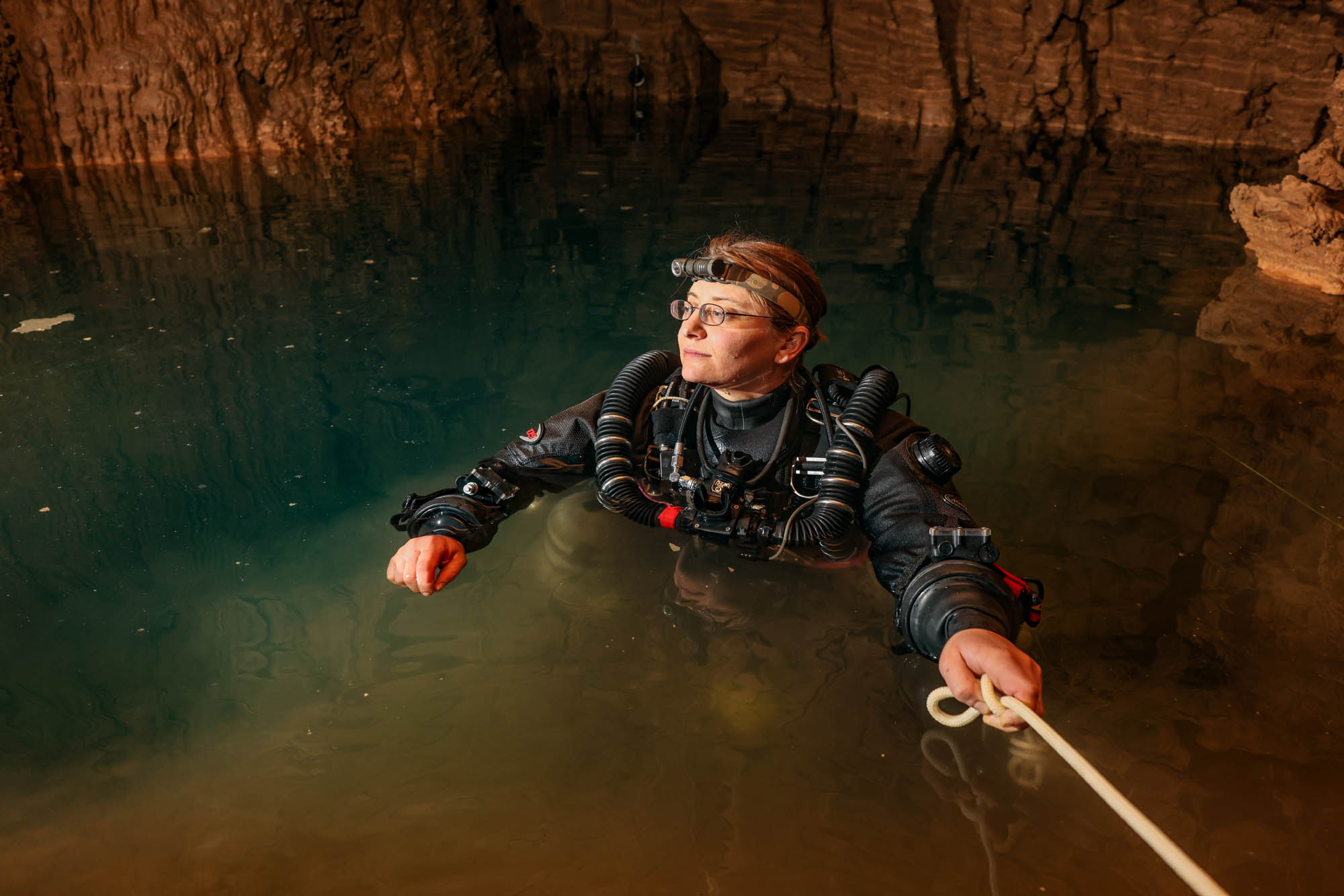
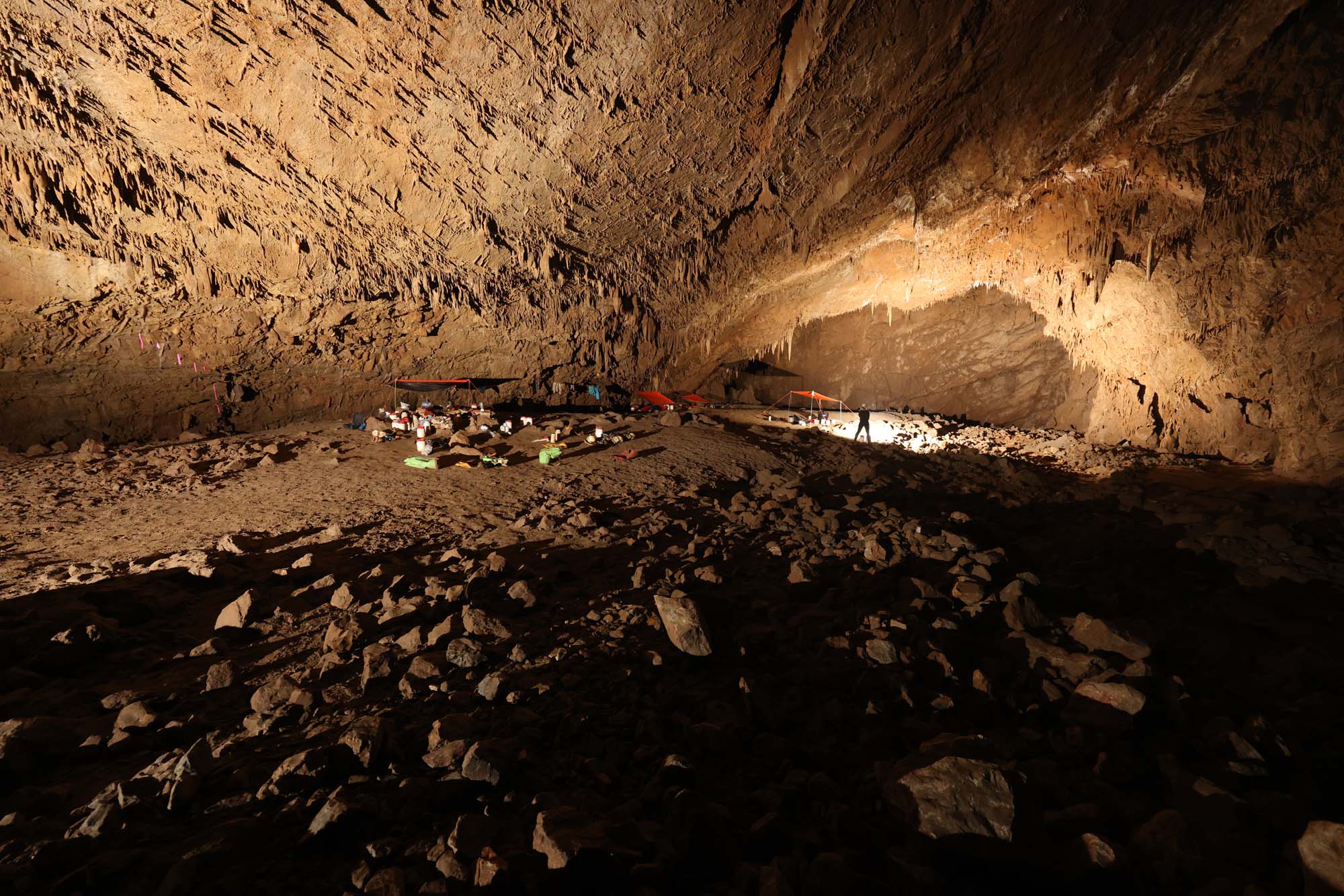
Nearly the entire ADW descent to Camp 7B is on rope and had seen no traffic for two years. Rigging repairs, phone line checks and general equipment hauling (with a depot established at the -300m level in ADW) took place in early February, with Cruz, Cumplido, and Espinasa handling the rigging and Shade and Ward running the phone line from the ADW entrance to Harmony Hall. Adrian Miguel Nieto had also kindly stopped in from Mexico City for two depot runs from the surface. On February 10 the dive team entered the cave and a general hauling cycle initiated between the surface, the ADW depot and Harmony Hall. A total of 21 haul sacks were involved, half of which were dedicated to dive gear. By February 13 sufficient supplies were in Harmony Hall that the dive team moved there and re-established Camp 7 after 5 years of vacancy. The camp was an eclectic collection of drip tarps suspended over sleeping areas using tent poles and parachute cord. Despite the vast potential for camp sites in the enormous chamber, the 40 m wide roof was covered with thousands of stalactites, all of which dripped. Exploration of the East Sump Following a day of equipment re-assembly at the East Sump the first exploratory dive took place on February 15th. While it had initially been hoped that with the clean flowstone entry the visibility would be favorable, this proved not to be the case. It was decided that for safety, exploration would be done solo and with Elor, using a KISS Sidewinder rebreather rig. Thirty metres into the first exploration dive, it became immediately clear that our ambitious expectations of establishing Camp 10 on the far side by mid-February had to be tempered. Not only did the visibility prove to be effectively zero, the floor, ceiling and walls were covered with bulbous semi-spherical formations that were faced with large, razor-sharp crystals. The floor had an inch of dense mud that leapt into the water column with the slightest disturbance and did not clear. And there were no objects or other projections anywhere for dive line tie-offs. As a result, more than a week of extremely tedious diving, and 25 kg of lead drop weights, were needed to tease out the way through this surprisingly complex place and position a safety line that avoided line traps. In the end the route followed an undulating mud-covered flowstone floor with numerous crystalline restrictions before emerging 55 m later through a 1 m wide fissure where the meager flow rippled over a flowstone dam and into a 1.5 m wide canyon that continued into the distance. By February 22 the East Sump was cracked. 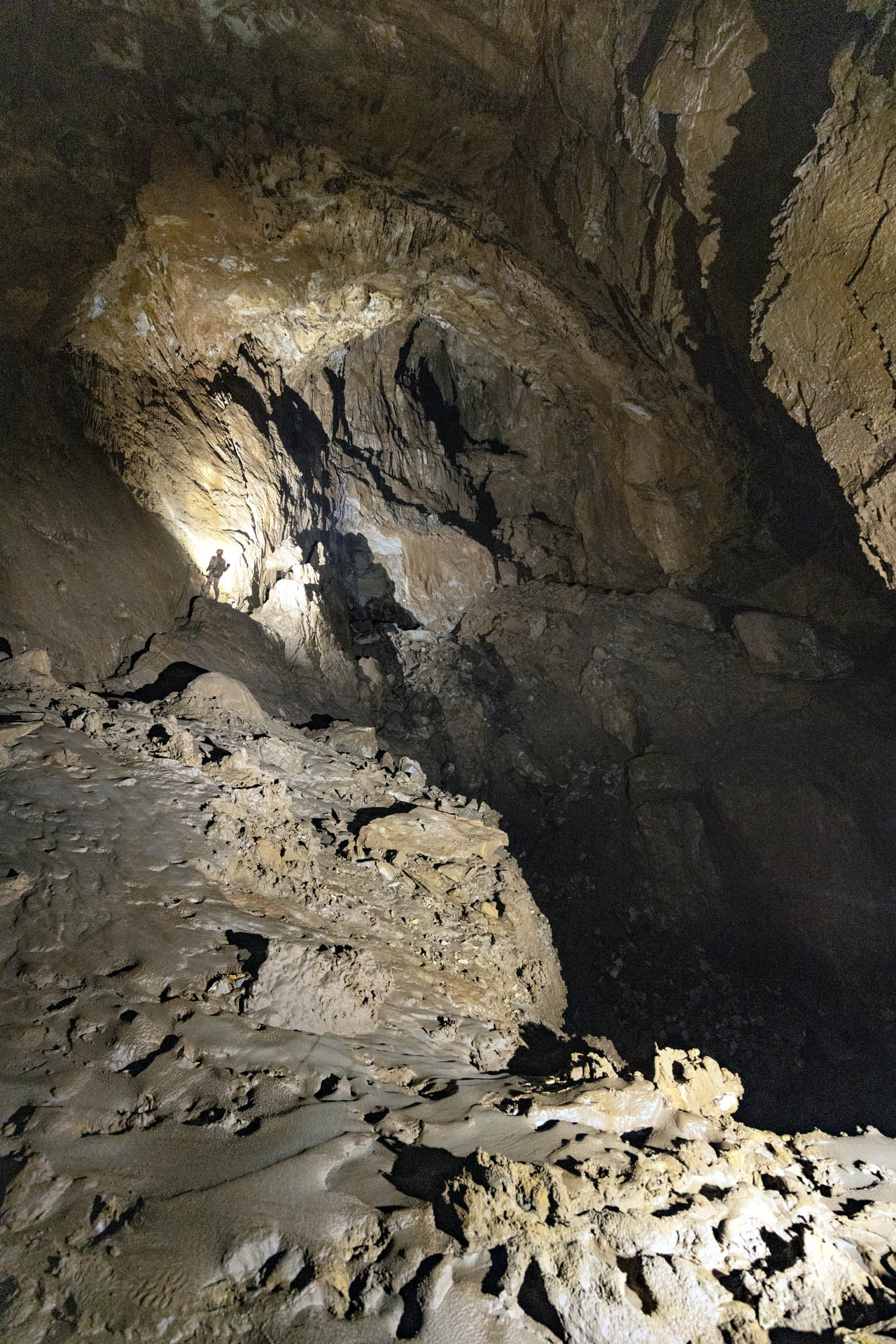
An initial recon beyond the East Sump took place on February 23. Elor and Stone conducted a two hour foray in wetsuits and without vertical gear. They free climbed a 12 m pitch leading out of the sump and emerged onto a balcony 40 m high on the wall of a 45 m diameter chamber. The ceiling extended upwards another 15 m and echoes persisted for 5 seconds. While they were able to reach the floor of the chamber through a series of exposed mud-covered climbs, other possible continuations remained uninvestigated as they had no rigging equipment. The big chamber gained the name “The Hall of the Jelly Bean King” (HOTJBK). This was a play on Tolkien and the fact that Oscar Barrones was addicted to Jelly Belly Beans, of which there was a small supply in the Camp 7 provisions. To facilitate gear hauling and regular open circuit dives, the thin exploration guideline was replaced with a 9mm rope running through the sump anchored securely with a large number of lead drop weights. While the 9mm rope now allowed for pulling rather than finning - significantly reducing air consumption - a transit through the East Sump still remained a far more intimidating experience than any other sump on the mountain due to the visibility. Meanwhile, in parallel, regular haul runs from the surface to the depot and from Camp 7 to the depot and back were taking place to bring in diving equipment for Bristol and Berrones. By March 1, after 15 days of working from Camp 7, the stage was finally set for extensive exploration beyond the East Sump. Exploration Beyond the Sump: The Eastern Borehole During the February 23 recon a possible continuation was spotted with a tight-beam dive light at the southeast corner of the HOTJBK chamber at approximately the same level as the balcony, still 40 m off the floor of the chamber. On March 1, with Stone belaying, Elor led a 50 m traverse along the south wall of the chamber after which a fixed line was installed. The pocket turned out to be a going, aragonite-encrusted canyon. A total of 300 m of large tunnels, heading east, were discovered on a 9 hour push. After several aid climbs, the team found a massive canyon leading to a junction chamber dubbed the "Pentafurcation." From there, they explored another 120 m of mostly walkable passage before climbing a fissure that unexpectedly connected back to the end of an earlier exploration route. Seeking an eastward continuation, Berrones, Elor and Stone returned to the Pentafurcation chamber. Initial aid climbs above the chamber led only to an ascending fissure with no clear signs of an eastern route. A renewed search uncovered a tunnel leading from the Pentafurcation to a large new chamber, dubbed the "Hilti Power Room," with two promising climbing leads. One climb opened into 220 m of large walking passage before ending abruptly at what is likely the Hermosa II fault. Multiple subsequent trips explored the fault-controlled canyon finding no breakthrough. Berrones exited the cave on March 21. Stone and Elor conducted two further diving pushes on March 23 and 25th focused on the eastern branch. During the final 15 hour push an aid climb by Elor at the mid-height of the southeast fissure led to a 40 m extension of the fissure where flowstone intrusion mostly blocked the tunnel. A slight outward airflow was observed at the limit of exploration. 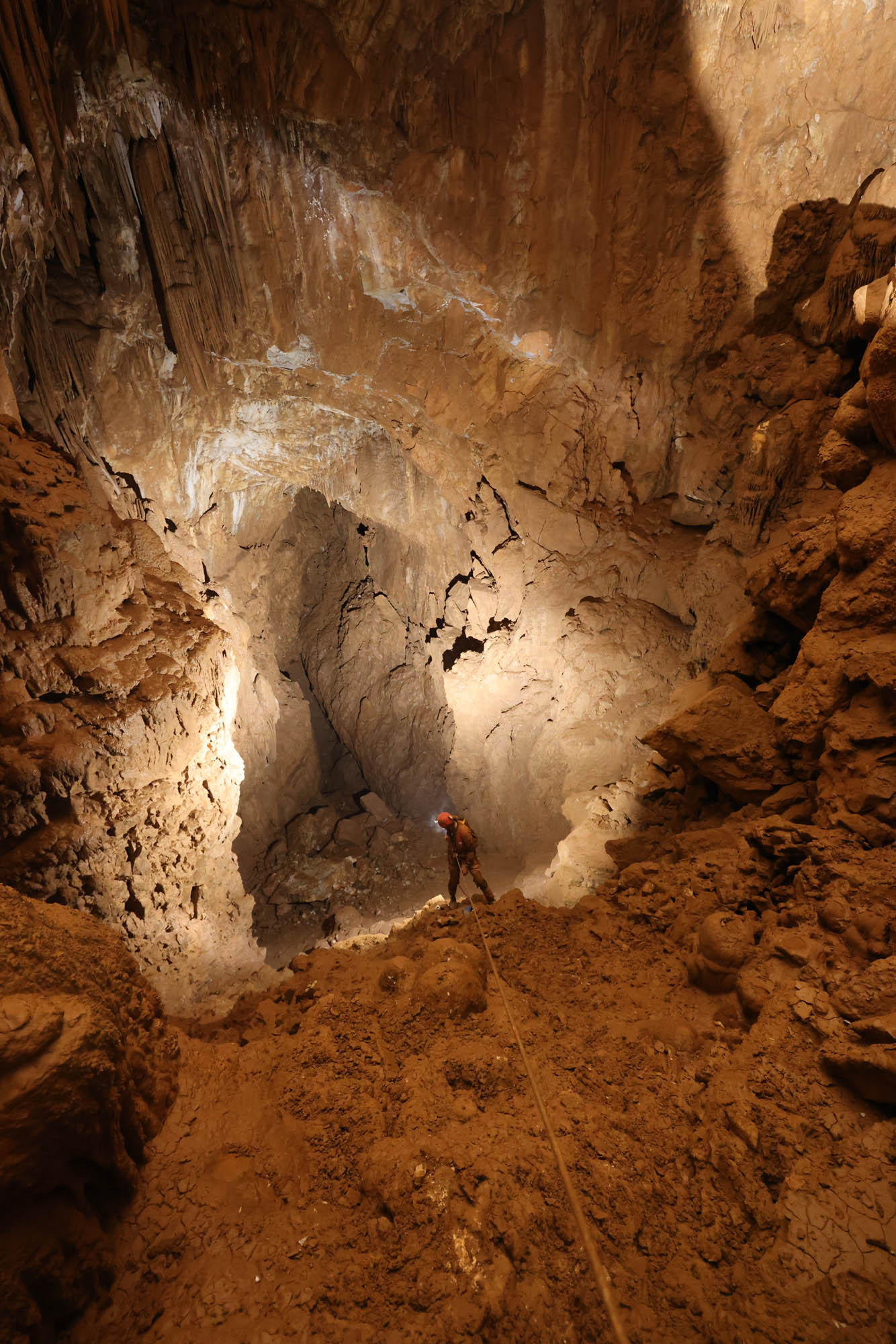
Exploration Beyond the Sump: The North Pole Canyon Exploration of what had been considered a likely western branch leading out of the HOTJBK chamber began on March 5 - an exposed, 20m steep mud-covered breakdown slope led to a summit where the tunnel promptly dropped 20 m vertically in an aragonite-encrusted fissure. Almost immediately the continuation enlarged into a 15 m wide x 25 m tall borehole going steeply uphill again to a summit 50m up where a 3-way junction was discovered in a chamber reaching 70m across. From this formation-encrusted saddle the North Lobe continued for 60 meters, descending down a mud-covered breakdown pile into a 50 m diameter chamber. On April 12 three climbs and two traverses up to the northwest corner crack in the North Lobe chamber led to a formation-filled tunnel (North Pole canyon) which widened to 20m width and steepened, going downhill over mud-covered breakdown with strong wind blowing up. At approximately 120m from the North Lobe chamber the new tunnel suddenly terminated in a round flat-roofed room (the Aurora Chamber) some 20m in diameter that was packed with impressive formations. The airflow was coming from a vertically descending breakdown maze at the bottom of the chamber. The team followed the breakdown maze 30m down before running out of time in late April. The survey would later show that the northern wall of this chamber was 70 m further north than the 2021 limit of exploration marking the northernmost point in Sistema Cheve. It is also just 12 m above the deepest point in Cheve. Dry Exploration From the beginning of the expedition through March 9, the diving team had been generously supported with countless hauling runs to the depot from both the surface and from Camp 7B by the remaining team (Shade, Ward, Cruz, Cumplido, Espinasa, Gerson Carrera, Vlad Paulik and Tiffany Hassett who had arrived in the middle of February). Once the East Sump had been cracked and daily exploration and mapping was underway beyond, these 9 began parallel exploration projects. The 70m Aid Climb at Southeast Harmony Hall: On February 21 Cruz, Cumplido and Espinasa arrived at Camp 7 with aid climbing gear to investigate the southeast corner of Harmony Hall. Using a Dive Rite FX40 primary cave diving light they had spotted a prominent hole in the roof, 70m up. The three conducted multiple climbing trips over several days to scale up the wall, complicated due to the incredibly poor quality of the rock, finally topping out late in the day on March 6. They reported that the blackness was a pocket chamber measuring 10m wide and 5m deep with no horizontal passage leading off. Rumbling Wells: Earlier on February 19 Cruz, Cumplido and Espinasa had ascended to Camp 8, via the Paddle Creek route last used in 2024. They repaired the rigging and phone line along the way. They then returned to Camp 7B to continue the Harmony Hall aid climb. By February 22, Paulik, Shade and Ward had moved to Camp 8. They began a series of exploration pushes to the promising RYE lead discovered by Paulik and Tiffany Hassett in 2024. They rapidly descended 80m below the 2024 limit where the passage appeared to end in breakdown. This was to remain the situation until March 4 when the same team, now including Hassett, returned for a four day push from C8. After multiple days of exploration and rigging, a connection was made on March 6th into the roof of the Shining Path borehole - yielding a dry route between Camps C7B, C7, and C8, bypassing the original wet route up Paddle Creek. Amor Fati is Latin for Love Thy Fate (or, conversely, every obstacle is “fuel” for your own growth). This passage begins at a pit most of the way south in Boreholio and meanders east of Boreholio and the underlying Too Good to be True tunnel near the Dream Theater. Tiffany Hassett and Aidan Ward explored this 276 m section of cave from Camp 7B, involving 4 hours of daily commuting (hence the unusual name for the passage; in addition the pair made depot supply runs for the dive team during their “rest days” ). The tunnel is developed on a 45° fault that extends to a point just 100 m north of the Dream Theater and remains east of all known tunnels. It currently ends in breakdown, but there is airflow. In Search of an ADW-C8 connector: The ADW descent route parallels and mimics the Paddle Creek upstream route from Camp 7B to Camp 8. If a high elevation connection between the two could be made, it would cut off hours of travel from the surface to Camp 8. On March 26 Corey Hackley and Keely Owens began looking for such a connection. On April 3 they discovered a tight crawlway leading northeast off the down-dip lift tube approximately 70m from the Paddle Creek junction. The crawlways were ascending and passed 20 m below the ADW tunnel they were trying to connect to. The following day they discovered an 8m diameter tunnel, now heading northwest and down dip, carrying water. On April 5–6, the Camp 8 team continued north in a descending lift tube. They rigged a 23m pit into a 50 m diameter low-ceiling chamber, dubbed the Global Perspective Vortex (GPV), where three infeeding waterfalls converge, ultimately dropping down into a 33m pit leading to a northwest descending stream. Hackley and Owens made a final exploration push on the downstream canyon on April 8. They were able to follow the diminishing cross section fissure to a low airspace restriction that stopped forward progress. Noticeable outflowing air issued from a 14cm diameter hole over the water surface. A return to the limit of exploration was made on April 10 by Matt Covington, Yuri Schwartz and Riannon Colton based from Camp 7B. Colton went swimming in the low airspace restriction but was unable to pass the obstacle. On April 21, Elor and Covington made a final trip from Camp 7B, exploring leads around the GPV chamber and recovering gear. Three additional tunnels were explored from the chamber but all ended without promising continuation. 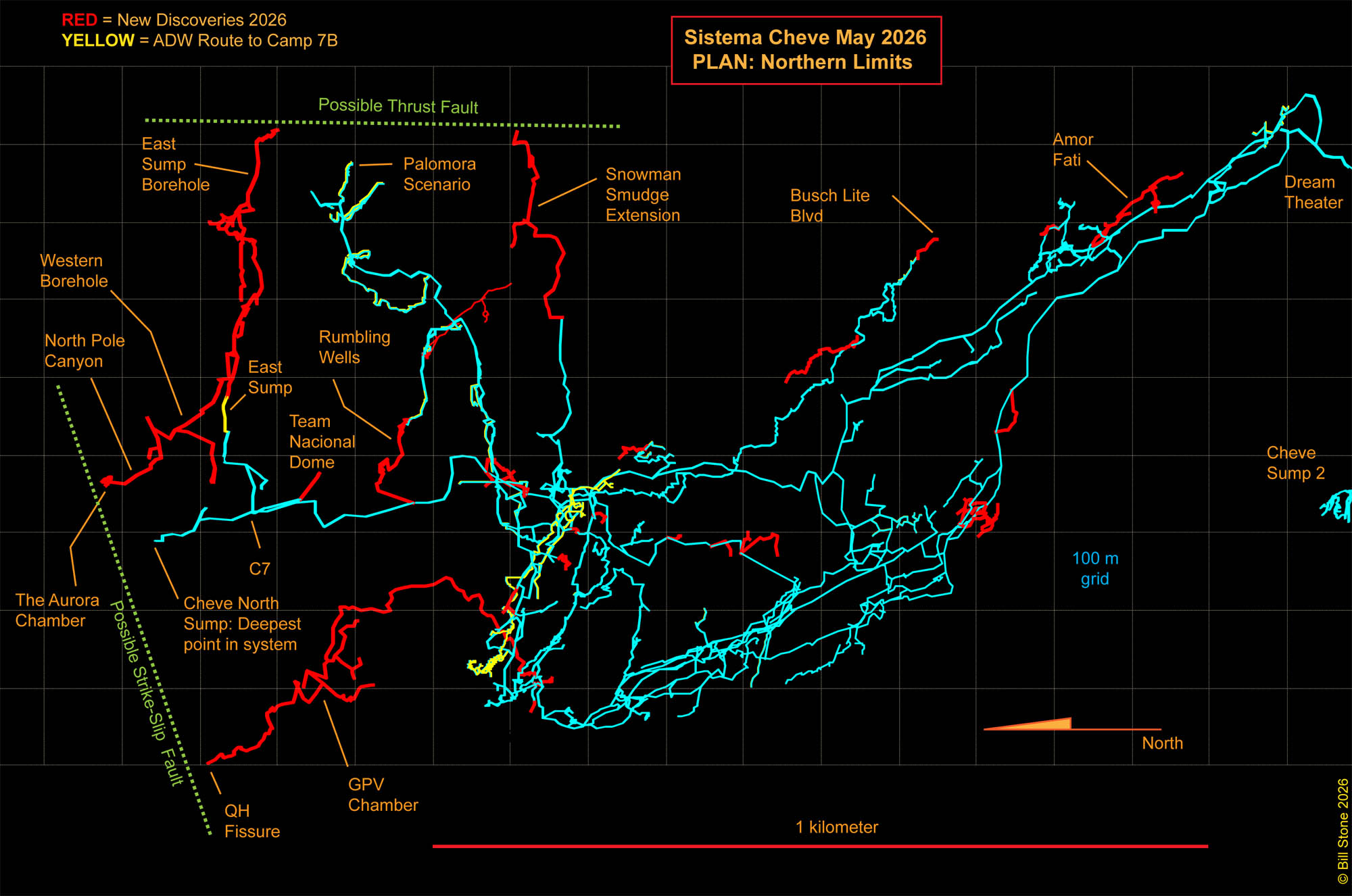
The grid size on the map is 100 m and north is to the left. Map by Bill Stone. 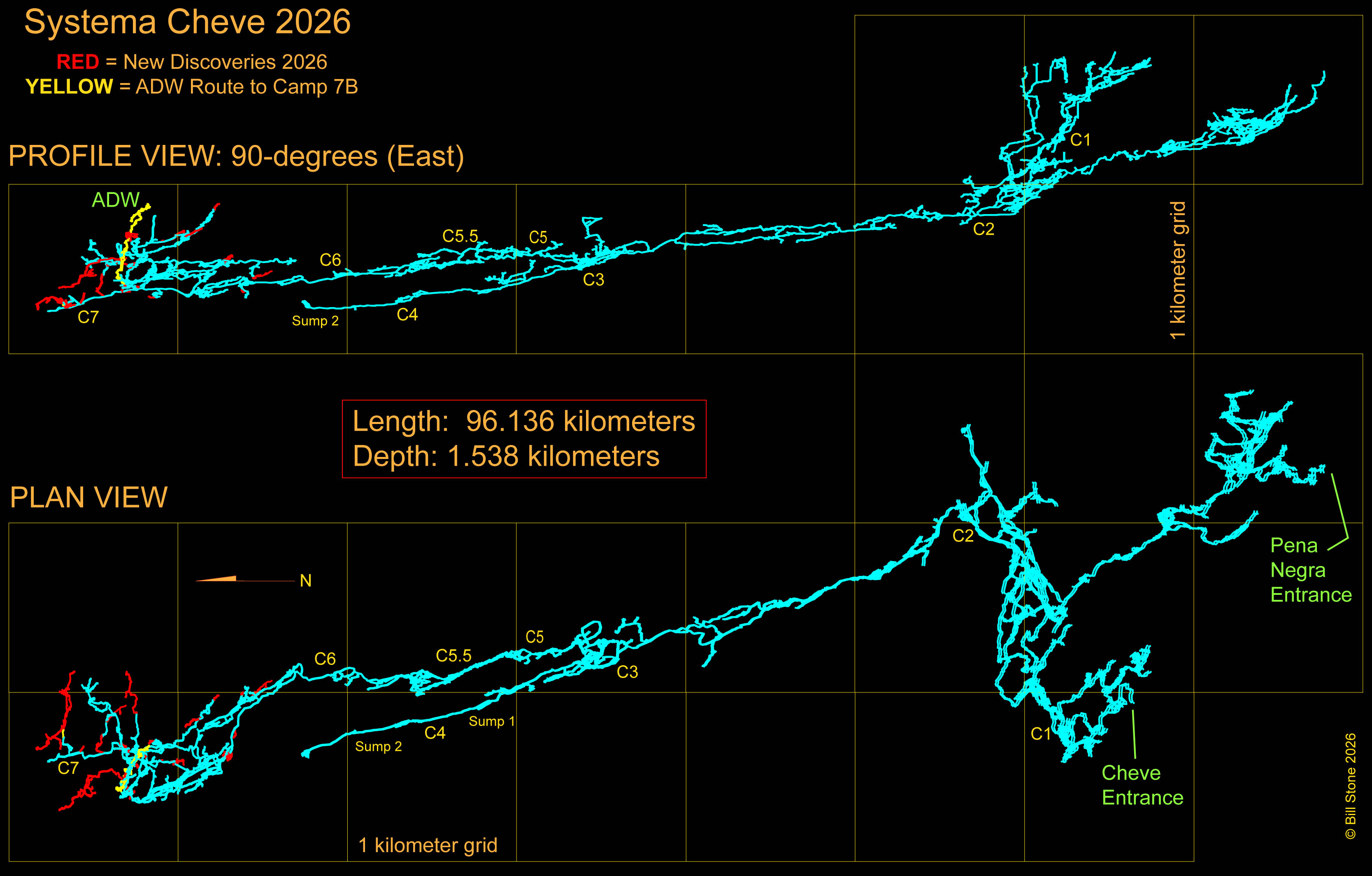
The Derig On April 19 Camp 7 was packed up, inventoried, and a remaining skeleton crew (Covington, Colton, Elor, Kerr and Stone) moved 21 bags to Camp 7B. Over the next five days this was all moved up to the high point depot in ADW. Then, beginning on April 22 the "cavalry" arrived in the form of Claudio Cruz and a small army of volunteer cavers from Mexico city who generously carried out multiple haul runs from the surface to get the last of the gear out. Summary Statistics During the course of the 3-month expedition a total of 5,237 m of new passages were discovered in Sistema Cheve, bringing the total length to 96,136 m. The six largest survey segments were: Beyond the East Sump [1,556 m]; GPV-North Stream [1,231 m]; Snowman Smudge [452 m]; Rumbling Wells [314 m]; Amor Fati [276 m]; and Busch Lite Blvd [232 m]. The depth remains the same at 1,538 m. The average team size was 11 - a total effort of 938 person days. Despite this small crew size significant breakthroughs were made. An extraordinary amount of time - 62 days - was spent by the dive team based out of Camp 7, once considered the “end of the world” in terms of remoteness. The longest single push was 28 days (the second longest was 22 days). Without this sustained effort, and the unrelenting support of a large portion of the team, the tunnel complex beyond the East Sump would never have been explored. | |
|
Home | ||
| Copyright © 2026 U.S. Deep
Caving Team, Inc. All rights reserved. Todo el contenido tiene derechos de autor del U.S. Deep Caving Team. Todos los derechos reservados. No portion of these pages may be used for any reason without prior written authorization. | ||